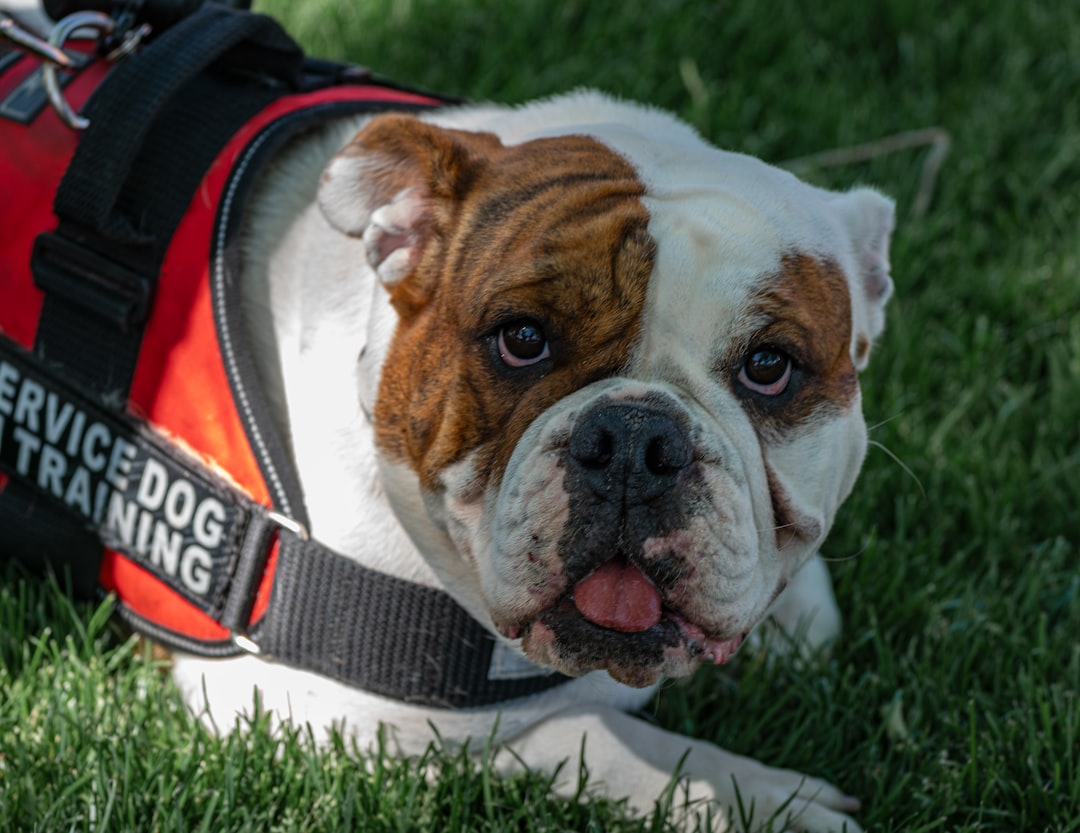
Why Biometric Verification Belongs in Handler-Dog Team Portals
The verification of service dog handler teams has long occupied an uncomfortable legal and technical middle ground. Businesses have a right to ask two specific questions under the Americans with Disabilities Act. They cannot demand documentation. Yet the entire ecosystem of digital verification portals has historically relied on document uploads, static credentialing cards and QR codes that prove nothing about the live human-animal team presenting at the door.
That gap is where biometric authentication becomes not just useful but structurally necessary. The question is not whether biometrics belong in handler-dog team verification. The question is how to deploy them in a way that is privacy-preserving, clinically appropriate and legally defensible under current federal doctrine.
As a 501(c)(3) nonprofit healthcare provider, TheraPetic® Healthcare Provider Group has spent years working at the intersection of clinical documentation and access verification. The team behind HANK AI and verify.mypsd.org has observed firsthand how static document-based verification fails all parties: it burdens handlers, exposes businesses to liability and creates a false sense of security from documents that can be counterfeited in minutes. Biometric verification changes that calculus entirely.
This article examines the technical architecture required to do biometric authentication correctly in this specific domain, including template storage models, liveness detection pipelines, ADA legal constraints and the algorithmic fairness obligations that any responsible deployment must satisfy.
Template Storage Architecture and the Privacy-Preserving Design Imperative
The foundational decision in any biometric system is where and how biometric templates are stored. A biometric template is not the raw image or audio captured at enrollment. It is a mathematical feature vector extracted from that raw input. For facial recognition, this vector typically encodes geometric relationships between facial landmarks. For gait or iris systems, the encoding differs but the principle is the same: the template is a compact, non-invertible representation of the biometric signal.
In handler-dog team portals, the recommended architecture follows a federated template storage model. The raw biometric capture never leaves the device. Feature extraction runs on-device using a locally deployed neural network. Only the resulting template vector is transmitted to the verification backend, and even that transmission occurs over an end-to-end encrypted channel using TLS 1.3 with certificate pinning.
On the server side, templates must never be stored in plaintext. The current best practice in the field is cancellable biometrics, also called revocable biometrics, which applies a one-way transformation to the template before storage. If the template store is ever compromised, the raw biometric cannot be reconstructed. The handler can simply re-enroll using a new transformation function, something impossible with a stolen password but historically impossible with stolen biometric data too. Cancellable biometrics solves that problem.
NIST Special Publication 800-76 and the NIST Biometric Quality Standards provide the technical baseline for template fidelity and storage security that any production deployment should follow. For healthcare-adjacent platforms operating under HIPAA, the template store must also satisfy the HIPAA Security Rule's administrative, physical and technical safeguard requirements. If the biometric is enrolled in connection with a clinical encounter, the template may constitute protected health information and must be governed accordingly.
At verify.mypsd.org, the TheraPetic® team has structured its data governance model through mydatakey.org, which provides handler-controlled data sovereignty. Each handler controls their own encryption keys. The verification portal requests a cryptographic proof of identity rather than the template itself, a zero-knowledge proof architecture that eliminates the need for the server to ever hold a decryptable template.
Liveness Detection in a Clinical and Legal Context
Template storage security is meaningless without liveness detection. A biometric system that can be spoofed with a photograph, a 3D-printed mask or a replay attack provides only the illusion of verification. Liveness detection, also called presentation attack detection, is the mechanism that ensures the biometric signal originates from a live human being at the moment of verification.
For handler-dog team portals, liveness detection must operate across two subjects simultaneously: the human handler and the dog. These are technically distinct problems requiring different model architectures.
For handler liveness detection, the current state of the art uses a combination of passive and active techniques. Passive liveness detection analyzes texture, depth cues and micro-movement patterns in a single image or short video clip to distinguish a live face from a photograph or mask. Active liveness detection prompts the user to perform randomized actions: blink, turn the head, smile. The randomization matters because it defeats pre-recorded replay attacks.
ISO/IEC 30107-3 is the international standard governing biometric presentation attack detection and defines the metrics any production system should report: Attack Presentation Classification Error Rate and Bona Fide Presentation Classification Error Rate. Any vendor claiming liveness detection capability without reporting these metrics against a recognized benchmark dataset should be treated with significant skepticism.
Dog liveness detection is a substantially harder problem that has received far less attention in the academic literature. Computer vision models trained on human faces do not generalize to canine subjects. The TheraPetic® team working on HANK AI has explored adapted architectures using canine-specific landmark detection, coat texture analysis and snout geometry encoding. The dog's biometric is not primarily for liveness in the human-security sense. It functions as a team identifier: the same handler with a different dog produces a non-matching team signature, which catches the common fraud pattern of borrowing a certified dog without being the legitimate handler.
In a clinical context, liveness detection also carries a dignity dimension that technical teams sometimes overlook. A handler with a motor disability or a facial difference may not be able to perform the same liveness gestures as an unimpaired user. The verification pipeline must include accessible fallback pathways that do not compromise security while accommodating the full range of human variation. This is not merely a design preference. It is an ADA obligation.
ADA Documentation Non-Requirement Doctrine and the Biometric Paradox
The ADA's documentation non-requirement doctrine is one of the most misunderstood rules in the service animal space. Under the ADA, a business or place of public accommodation cannot require a service dog handler to present any documentation, certification or ID card as a condition of access. The DOJ has consistently enforced this position. State laws that attempt to create voluntary registries do not alter the federal baseline.
At first glance, biometric authentication appears to conflict with this doctrine. If requiring a paper card is prohibited, how can requiring a biometric scan be permitted?
The answer lies in the distinction between mandatory access verification and voluntary portal participation. Biometric authentication in a handler-dog team portal is never a condition of physical access. The ADA's two-question rule governs what can be asked at the point of entry. A verification portal is a separate system that handlers elect to use because it provides them with documented, portable proof of their team's legitimacy that they can share proactively with businesses, airlines, housing providers and other entities where the service dog question arises.
Under this framework, biometric enrollment is an opt-in service, not an access requirement. The handler chooses to verify their team's identity through the portal to obtain a verification artifact (typically a cryptographically signed token or a QR code linked to a live record). That artifact can then be presented voluntarily in contexts where the handler wants to streamline the interaction without the business treating it as a mandatory credential.
The legal position is analogous to TSA PreCheck. No traveler is required to enroll. Those who do enroll voluntarily submit biometric data in exchange for an expedited experience. The underlying security rights of non-enrolled travelers are unaffected.
For housing providers governed by the Fair Housing Act rather than the ADA, the documentation landscape is slightly different. HUD guidance permits housing providers to request reliable documentation for emotional support animals when the disability-related need is not apparent. A biometric-anchored verification artifact provides exactly the kind of reliable, tamper-resistant documentation HUD envisions, without exposing sensitive clinical records.
Multimodal Biometric Pipelines: Pairing Handler Identity with Dog Recognition
A single-modality biometric system, one that verifies only the handler's face, misses the most important fraud vector in this domain: the disassociation of a legitimate dog from its legitimate handler. The enforcement challenge is not primarily forged documents. It is borrowed equipment, including both vests and trained animals, being used by individuals who have no lawful claim to public access rights.
A multimodal pipeline addresses this by creating a fused biometric signature for the team as a unit. At enrollment, both the handler's biometric (facial geometry, optionally supplemented by voice or iris) and the dog's biometric (snout geometry, coat pattern distribution, ear shape) are captured in a single session. The system creates a compound enrollment record: a cryptographically linked pair of templates that must both match at verification time.
The fusion strategy matters. Early fusion combines raw feature vectors before classification. Late fusion combines classification scores from separate models. For handler-dog team verification, late fusion is generally preferable because the handler and dog biometrics require entirely different model architectures. Each model produces a confidence score and those scores are combined using a learned fusion function calibrated to minimize false acceptance of mismatched teams.
At the edge device level (a smartphone camera used by a business employee or the handler themselves), the pipeline must complete in under two seconds to be practically usable. This requires optimized model inference using quantized neural networks suitable for deployment on mobile hardware. TensorFlow Lite and Core ML are the dominant deployment targets. ONNX Runtime provides cross-platform flexibility for backends that need to support Android and iOS simultaneously.
The dog recognition component benefits significantly from transfer learning. Foundation models trained on large mammalian image datasets (ImageNet and its successors) can be fine-tuned on canine-specific datasets with far less training data than training from scratch would require. The TheraPetic® team has explored partnerships with veterinary institutions that hold longitudinal photographic records of identified animals, which provide the kind of temporally diverse training data needed to handle aging coat patterns and post-grooming appearance variation.
HIPAA Compliance, Algorithmic Fairness and Deployment Ethics
Handler-dog team verification sits in a complex regulatory intersection. The handler's disability status is protected health information when held by a covered healthcare entity. The biometric template is sensitive personal data under a growing number of state biometric privacy laws, including Illinois BIPA, Texas CUBI and Washington's My Health MY Data Act. A federal biometric privacy standard remains under development but has not been enacted as of 2026.
HIPAA Safe Harbor deidentification under the Privacy Rule's 18-identifier framework does not straightforwardly apply to biometrics. Biometric identifiers are one of the 18 categories that must be removed or transformed for data to qualify as deidentified. A verification system that retains biometric templates alongside clinical documentation of disability must treat the combined record as PHI and apply the full Security Rule safeguard stack.
Algorithmic fairness is not optional in this domain. Facial recognition systems have well-documented differential error rates across demographic groups, particularly for darker-skinned individuals and women. The NIST Face Recognition Vendor Testing program published findings documenting these disparities across commercial systems. Any biometric verification portal claiming to serve disabled handlers equitably must conduct demographic disaggregated accuracy testing and must not deploy a system with materially higher false rejection rates for any protected class.
Equalized odds is the appropriate fairness metric here: the system should have equal true positive rates and equal false positive rates across demographic groups, not merely equal overall accuracy. A system that achieves 98% accuracy overall but rejects Black handlers at three times the rate of white handlers is not a fair system. It is a discriminatory one.
The TheraPetic® Healthcare Provider Group's clinical team, led by Dr. Patrick Fisher, PhD, LPC, NCC, requires that any AI-assisted verification tooling undergo formal bias audit before production deployment. The audit framework follows recommendations from the Partnership on AI's ABOUT ML documentation standard and the NIST AI Risk Management Framework, which provides structured guidance for high-stakes biometric applications in the 1.0 release updated through 2026.
How TheraPetic® and HANK AI Are Building Toward This Standard
The verification portal at verify.mypsd.org represents the TheraPetic® Healthcare Provider Group's current production infrastructure for handler-dog team documentation. In its current form, the portal supports clinician-reviewed documentation, cryptographically signed verification tokens and handler-controlled data governance through mydatakey.org. The biometric layer described in this article represents the roadmap toward which the technical team is actively building.
HANK AI, TheraPetic®'s service animal AI research initiative, is developing the canine biometric component as a research prototype. The initial focus is on snout geometry encoding, which offers several practical advantages: the snout is the most morphologically stable region of a dog's face across lighting conditions, orientation variation and age. A ResNet-50 backbone fine-tuned on a curated canine dataset has shown promising retrieval accuracy in internal evaluations, though peer-reviewed publication of these results is pending external validation.
The handler biometric component is being evaluated using commercially available, ISO 30107-3 certified liveness detection SDKs that have undergone NIST FRVT testing. Integration with the zero-knowledge proof layer from mydatakey.org is in active development. The design goal is a system where no entity in the pipeline, not the verification portal, not the business scanning the QR code and not the clinical documentation provider, ever holds a complete picture of the handler's identity and disability status simultaneously.
For AI engineers and clinical informaticists evaluating this space, the servicedog.ai and therapetic.net resources provide ongoing technical documentation of HANK AI's architecture decisions. The TheraPetic® team welcomes collaboration from researchers working on privacy-preserving biometrics, federated learning and canine computer vision who want to contribute to a clinically grounded and legally defensible deployment.
The handler-dog team verification problem is harder than it looks. Solving it well requires clinical knowledge, legal precision, technical rigor and a genuine commitment to the privacy and dignity of disabled individuals. That combination is rare. It is also the only acceptable standard for a system with this much consequence.