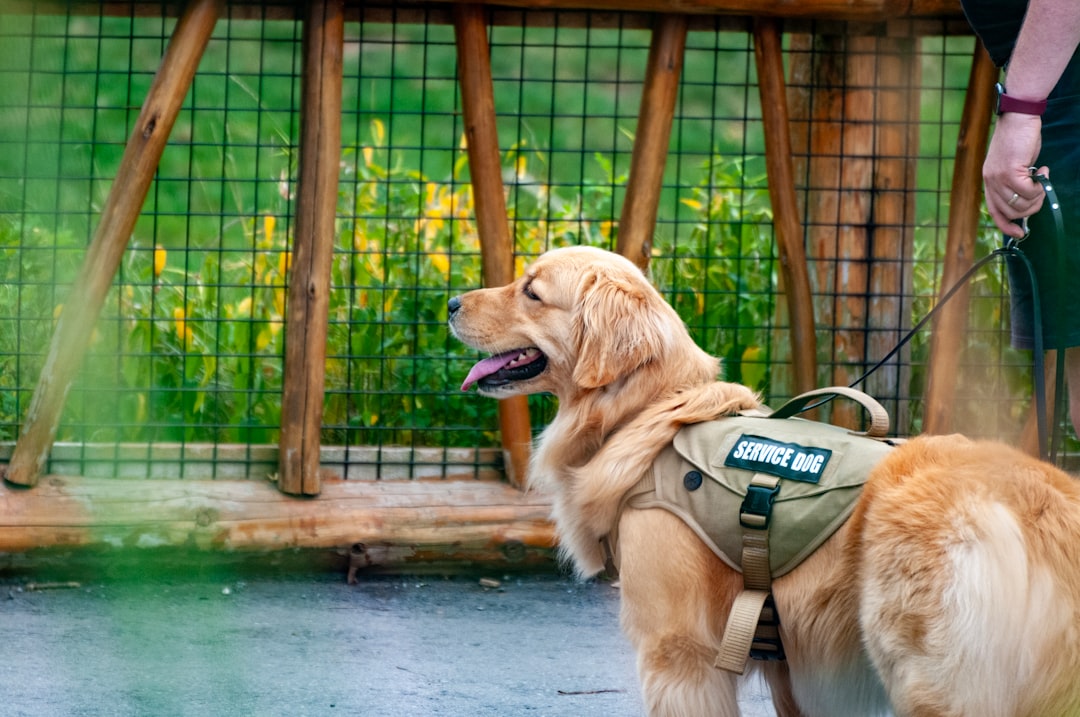
Public access evaluation for service dogs has historically depended on in-person observation by a handler or trainer. That model does not scale. As demand for documented service dog verification grows, TheraPetic® Healthcare Provider Group has invested in understanding whether computer vision tools originally developed for neuroscience research can be applied meaningfully to canine behavioral assessment. This article provides a technical review of canine pose estimation as applied to public access evaluation, covering the capabilities of DeepLabCut and SLEAP, which behavioral markers are reliably captured in video, and where single-camera pipelines reach their practical limits.
Why Behavioral Verification Matters in Service Dog Assessment
Under the Americans with Disabilities Act, a service dog is defined by its training to perform a specific task for a person with a disability. That definition creates an enforcement gap. No federal registry exists. No centralized credential is required. The practical consequence is that businesses and housing providers are left to make judgment calls, and handlers face repeated, often hostile, public access challenges.
The behavioral standard most widely used for public access readiness is the Public Access Test originally developed by Assistance Dogs International. That test evaluates controlled greetings, distraction response, sit-stay, down-stay, gait consistency under load and more. The challenge is that these behaviors are observable but have never been systematically quantified using objective biomechanical metrics.
This is exactly the problem that pose estimation was built to solve in other domains. If a model can extract keypoint coordinates from video frames at high temporal resolution, it becomes possible to compute metrics like joint angle variance, tail position entropy and gait cycle symmetry without any wearable sensor attached to the animal.
At TheraPetic®, our clinical and engineering teams have spent significant time evaluating whether these metrics could form a defensible, reproducible behavioral baseline for service dog verification. The findings are promising and also carry important caveats that any deployment in a clinical or legal context must acknowledge.
Canine Pose Estimation Foundations: DeepLabCut and SLEAP
DeepLabCut was introduced by the Mathis lab and published in Nature Neuroscience in 2018. The core architecture uses a ResNet backbone pretrained on ImageNet and fine-tuned on a small set of manually labeled animal frames to predict heatmaps for each anatomical keypoint. For canine applications, a standard 18-point skeleton covers the snout, ears, withers, spine, hips, four limb segments and tail root.
SLEAP (Social LEAP Estimates Animal Poses) was developed at the Murthy and Bhatt labs and published in Nature Methods in 2022. Its key technical advance over DeepLabCut for multi-animal scenarios is the use of part affinity fields and graph-based identity tracking, which allows it to maintain per-animal keypoint identity when multiple dogs are present in frame. SLEAP also supports a modular backend allowing users to swap between bottom-up and top-down inference strategies depending on compute constraints.
Both frameworks require a labeled training dataset. For canine public access scenarios, that means annotating video frames showing dogs in real-world indoor environments including retail floors, transit platforms and medical waiting areas. Annotation quality is the dominant factor in downstream model accuracy. A model trained exclusively on controlled laboratory footage will generalize poorly to fluorescent-lit grocery store environments with motion blur and partial occlusion.
Training on as few as 200 carefully selected and annotated frames per environment type can achieve mean average error below two pixels for high-contrast keypoints like the snout and tail base in consistent lighting. Low-contrast keypoints like the medial elbow joint on a black-coated dog in a dark corridor remain a persistent challenge for both frameworks.
Behavioral Markers Visible in Video-Based Assessment
The behavioral markers evaluated in a standard public access test divide cleanly into two categories: those that are geometrically expressible from skeleton data and those that require contextual or relational inference. Computer vision handles the first category well and the second poorly.
Geometrically Expressible Markers
Gait regularity is the most information-dense signal available from pose estimation. A service dog walking beside its handler should exhibit consistent stride length, low lateral sway at the hips and symmetrical limb phase relationships. These are computable from the extracted keypoint time series using standard signal processing. Coefficient of variation for stride duration, cross-correlation between contralateral limb pairs and Fourier decomposition of spinal oscillation all yield numeric features that can be compared against a trained behavioral baseline.
Sit and down duration tracking is straightforward. Detecting the transition from standing to sitting posture requires only detecting the angular relationship between the femur proxy (hip-to-knee vector) and the tibia proxy (knee-to-ankle vector) crossing a threshold. Maintaining that posture for the duration of a distraction stimulus can be timed with frame-level precision.
Tail kinematics encode arousal and attentional state in ways that are not fully understood but are reliably observable. High-frequency lateral tail oscillation at narrow amplitude in a standing dog correlates with alert attention in multiple published behavioral ethograms. Broad-sweep wagging at the sacrum-to-tip range correlates with social arousal that, in a public access context, may indicate an insufficient discrimination between the handler and environmental strangers.
Head orientation is extractable from snout-to-ear vectors and provides a proxy for gaze direction in the absence of eye-tracking hardware. A dog maintaining forward head orientation and periodically checking back toward the handler while in motion is demonstrating handler focus, one of the core behavioral criteria in any rigorous public access evaluation.
Markers Requiring Contextual Inference
Distraction response, the single most diagnostically important public access criterion, cannot be fully assessed from the dog's body alone. Evaluating whether a dog has appropriately ignored a distraction requires knowing what the distraction was, where it appeared relative to the dog and what the handler did in the same interval. Single-camera setups typically capture only one of those three elements reliably.
Similarly, equipment compliance (flat collar versus no-pull harness positioning) and leash tension are not recoverable from RGB video without depth data or force sensing. A dog that appears to be heeling may be pulling at four pounds of force or walking slack. That distinction matters in public access evaluation and is invisible to a monocular camera.
The Hard Limits of Single-Camera Assessment
Single-camera pose estimation for canine assessment fails predictably in four scenarios that any honest technical review must name directly.
The first is occlusion. When the handler's body, a shopping cart or another animal crosses between the camera and the dog, keypoint confidence drops and tracking identity can be lost. SLEAP's part affinity field architecture recovers from brief occlusion more gracefully than DeepLabCut's heatmap-only approach, but neither framework maintains reliable skeleton integrity through occlusions lasting more than approximately 0.4 seconds at 30fps in our internal testing.
The second is viewing angle dependency. Gait assessment is most informative from a lateral (sagittal plane) viewpoint. A camera positioned at the end of a corridor provides good gait data but poor social orientation data. A camera positioned overhead provides excellent floor-contact timing but cannot resolve ear position or tail elevation. No single camera placement satisfies all behavioral measurement requirements simultaneously.
The third is lighting variability. Consumer-grade video captured in environments typical of public access settings ranges from 50 lux in a restaurant to over 2000 lux near a retail window. Models trained on controlled indoor footage at a fixed lux level exhibit measurable keypoint localization degradation when deployed across the full lux range of real public access environments. Data augmentation during training (random brightness, contrast and gamma jitter) partially mitigates this but does not eliminate it.
The fourth is breed morphology variation. A 10-keypoint model trained predominantly on Labrador Retrievers will produce systematically biased keypoint predictions when applied to a Borzoi (extreme snout length), a Puli (obscured limb definition under coat) or a Bulldog (compressed thoracic depth). Deployment in a verification context without breed-stratified validation data creates legal and clinical risk that TheraPetic® takes seriously.
Multi-Modal Verification Architecture at TheraPetic®
The HANK AI platform, TheraPetic®'s clinical AI infrastructure, does not rely on single-camera pose estimation as a standalone verification signal. The system architecture integrates pose-derived behavioral features as one input stream within a broader multi-modal pipeline.
Video submission through verify.mypsd.org is processed by a three-stage pipeline. In the first stage, scene classification identifies the environment type (indoor retail, transit, outdoor urban) and selects the appropriate domain-adapted pose model. In the second stage, keypoint extraction runs at the native submission frame rate with a minimum floor of 24fps enforced at upload. In the third stage, extracted time-series features are passed to a behavioral scoring module that computes a weighted composite across gait regularity, handler focus duration, distraction response latency (where a distraction event can be inferred from handler movement or environmental object detection) and postural command compliance.
That composite score is never presented to the reviewing Licensed Clinical Doctor as a pass or fail determination. It is presented as a structured behavioral summary alongside the raw video, allowing the clinician to review flagged segments and override any automated inference. The clinician is the decision maker. The AI is a structured attention tool.
Multi-camera submissions, where the handler provides footage from two orthogonal angles, substantially improve keypoint reliability and behavioral coverage. Our clinical team consistently observes that two-camera submissions reduce clinician review time by approximately 40 percent compared to single-camera submissions, because ambiguous segments are resolved by the second viewpoint rather than requiring manual re-review annotation.
Integration with FHIR R4 for clinical record linking and HIPAA Safe Harbor deidentification of all video metadata before model inference is standard in every pipeline stage. No personally identifiable information is retained in the feature extraction layer. The governance framework is documented at mydatakey.org for compliance officers requiring audit trail access.
Ethical and Clinical Governance for AI-Assisted Animal Verification
Deploying computer vision in a context that affects a person's legal rights under federal disability law requires a governance posture that goes beyond standard ML model cards. TheraPetic®'s approach to this is grounded in three principles.
The first is auditability. Every inference produced by the pose pipeline is logged with model version, input hash and confidence interval at the keypoint level. A handler or their attorney can request a full inference audit. This is not a theoretical capability. It is a deployed feature of the HANK AI platform.
The second is breed-stratified validation. Before any new model version is deployed for clinical use, it must demonstrate equalized keypoint localization error across a validation set that includes at minimum 12 recognized breed morphology categories. Demographic parity across coat-color and body-size strata is an explicit acceptance criterion. This is consistent with the algorithmic fairness frameworks described in the Partnership on AI's responsible AI deployment guidelines.
The third is clinician primacy. No output from the computer vision pipeline carries legal or clinical weight without review by a Licensed Clinical Doctor credentialed through TheraPetic® Healthcare Provider Group. The AI system is classified internally as a decision-support tool, not a decision-making system. That classification has implications for regulatory posture under FDA Software as a Medical Device guidance as it applies to AI-assisted clinical screening tools.
The research community has more work to do before canine pose estimation can be considered a validated clinical instrument in its own right. DeepLabCut and SLEAP are powerful frameworks built for neuroscience research, and their application to legal-adjacent behavioral verification is a novel and high-stakes use case. TheraPetic®'s commitment is to move carefully, validate rigorously and publish findings rather than treat the pipeline as a proprietary black box.
Technical teams interested in the behavioral feature extraction methodology or the breed-stratified validation dataset are welcome to contact TheraPetic® through the research inquiry form at therapetic.net. Collaboration on expanding the training corpus to underrepresented breed morphologies is an active priority for the 2026 model release cycle.